
Differences in Ancestry Affect the APOE ε4 Gene and Alzheimer’s Disease Risk

Ancestry-related Differences in Chromatin Accessibility and Gene Expression of APOE ε4 Are Associated with Alzheimer’s Disease Risk

In this study, we explored why the APOE ε4 gene increases Alzheimer’s disease risk more strongly in people with European ancestry than in those with African ancestry. We analyzed brain tissue from individuals with Alzheimer’s disease who all carried two copies of APOE ε4 but differed in their local genetic ancestry around the APOE gene. Our results showed that APOE ε4 was more active in brains with European local ancestry, especially in astrocytes, a type of support cell in the brain. We found that this increased activity was linked to greater chromatin accessibility, meaning the DNA near APOE ε4 was more open and easier to turn on in European ancestry brains. These ancestry-related differences were not limited to APOE alone but extended across the genome. Genes with increased accessibility in European ancestry astrocytes were involved in processes such as synaptic function, cholesterol handling, and astrocyte reactivity. In the discussion, we suggest that these molecular differences help explain why APOE ε4 confers higher Alzheimer’s disease risk in people with European ancestry compared to those with African ancestry. Our findings highlight that genetic risk depends not only on which variant a person carries, but also on ancestry-specific regulation of gene activity. This work underscores the importance of studying multiple ancestries to fully understand Alzheimer’s disease biology and to ensure that genetic insights are relevant to all populations

Rajabli F, Seixas AA, Akgun B, Adams LD, Inciute J, Hamilton KL, Whithead PG, Konidari I, Gu T, Arvizu J, Golightly CG, Starks TD, Laux R, Byrd GS, Haines JL, Beecham GW, Griswold AJ, Vance JM, Cuccaro ML, Pericak-Vance MA. African Ancestry Individuals with Higher Educational Attainment Are Resilient to Alzheimer’s Disease Measured by pTau181. J Alzheimers Dis. 2024;98(1):221-229. doi: 10.3233/JAD-231116. PMID: 38393909; PMCID: PMC11091636.

African Ancestry Individuals with More Education Show Greater Resistance to Alzheimer’s Disease, Based on pTau181 Levels

African Ancestry Individuals with Higher Educational Attainment Are Resilient to Alzheimer’s Disease Measured by pTau181

In this study, we examined why some African ancestry individuals show better daily functioning even when they have biological signs of Alzheimer’s disease. We focused on a blood biomarker called pTau181, which reflects Alzheimer’s disease pathology in the brain. Our results showed that African American individuals with higher levels of education were better able to carry out everyday activities, even when their pTau181 levels were high. This suggests that education may help protect against the functional effects of Alzheimer’s disease, a concept often called cognitive or brain reserve. We also found that this protective effect of education was stronger in people who did not carry the APOE ε4 genetic risk factor. In the discussion, we suggest that education may help the brain cope with disease-related changes, delaying or reducing functional problems. These findings highlight that social factors, like access to education, play an important role in Alzheimer’s disease outcomes. Studying African ancestry populations is especially important because most Alzheimer’s research has focused on European ancestry groups, which can miss important differences. We conclude that including diverse ancestries and life experiences in research is essential for understanding resilience to Alzheimer’s disease and for developing more equitable prevention and care strategies.

Rajabli F, Seixas AA, Akgun B, Adams LD, Inciute J, Hamilton KL, Whithead PG, Konidari I, Gu T, Arvizu J, Golightly CG, Starks TD, Laux R, Byrd GS, Haines JL, Beecham GW, Griswold AJ, Vance JM, Cuccaro ML, Pericak-Vance MA. African Ancestry Individuals with Higher Educational Attainment Are Resilient to Alzheimer’s Disease Measured by pTau181. J Alzheimers Dis. 2024;98(1):221-229. doi: 10.3233/JAD-231116. PMID: 38393909; PMCID: PMC11091636.
 

AD Plasma Biomarker Stability at −20°C in Resource-Constrained Settings

Exploring the stability of AD plasma biomarkers stored for extended periods at −20°C: Implications for resource-constrained environments

In this study, we wanted to see if blood markers linked to Alzheimer’s disease stay stable when stored for a long time at -20°C, a temperature many labs around the world can access. We found that these biomarkers, including those related to amyloid and tau, did not change much over time, even without ultra-cold freezers. This means that labs with fewer resources can still collect and store samples in a reliable way (up to 15 weeks).These results show that important Alzheimer’s research does not always require expensive equipment. Because of this, more communities and countries can take part in studies that help us understand the disease. This makes research more fair and more representative of people around the world. Our findings could help improve early testing and tracking of Alzheimer’s disease in places that have been left out before. Overall, this work supports better access to scientific tools and helps move Alzheimer’s research forward in a more inclusive way.

Ayele BA, Whitehead PL, Pascual J, et al. AD plasma biomarkers are stable for an extended period at -20°C: implications for resource-constrained environments. Preprint. medRxiv. 2024;2024.07.17.24310504. Published 2024 Jul 17. doi:10.1101/2024.07.17.24310504

Mining DNA for Alzheimer’s Secrets

Mining DNA for Alzheimer’s Secrets


By Josh Baxt

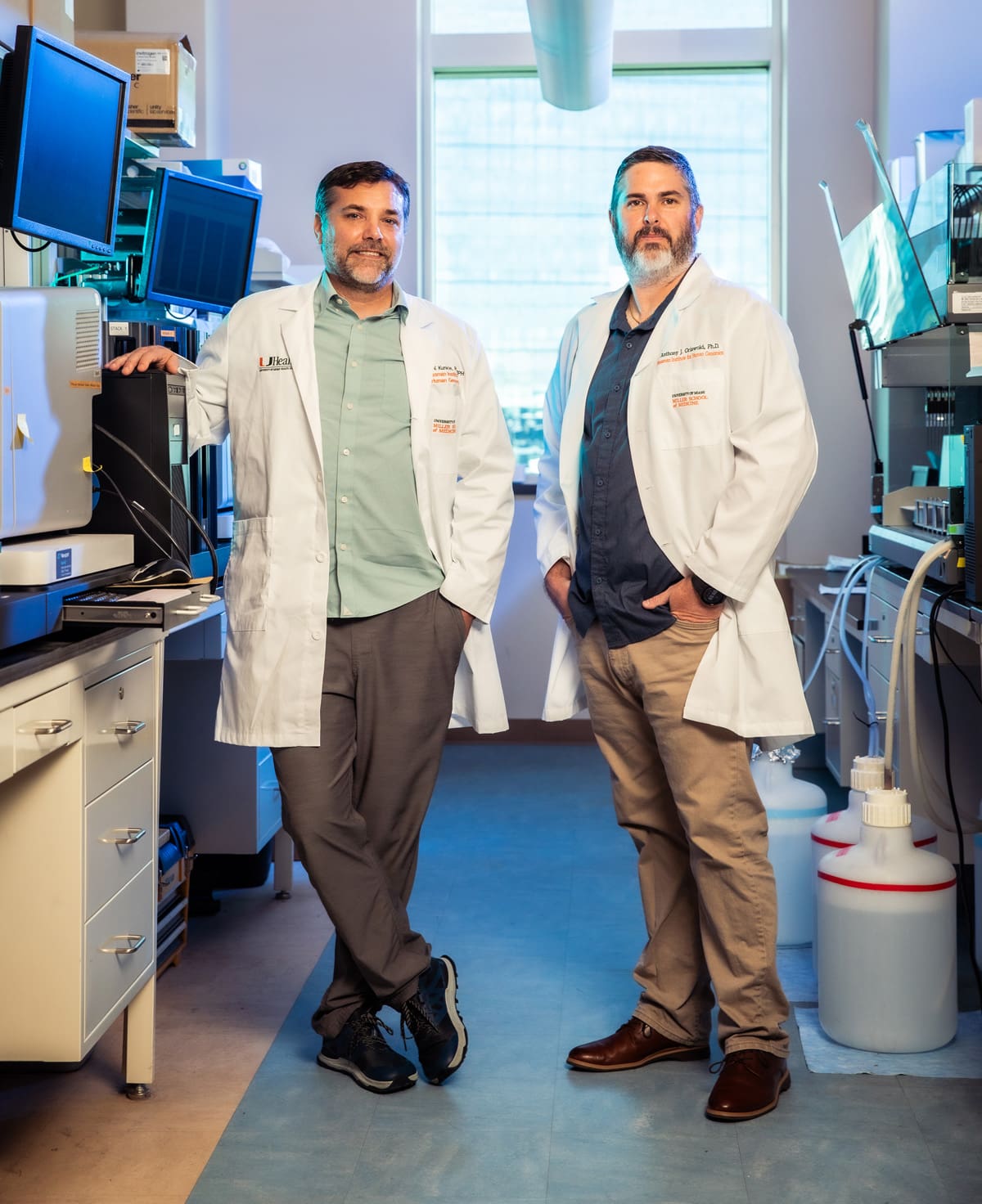
Researchers at the John P. Hussman Institute for Human Genomics (HIHG) at the University of Miami Miller School of Medicine are uncovering new insights into the genetic roots of Alzheimer’s disease, the most common form of dementia. Led by Anthony Griswold, Ph.D., and Brian Kunkle, Ph.D., M.P.H., the team is using advanced genome-wide association studies and whole-genome sequencing to identify genetic variations that influence risk and protection against the disease.

Their work casts a global net beyond populations of European ancestry to include groups from Africa, the Caribbean, and South America, revealing unique genetic markers and protective factors, such as variants in the APOEΣ4 gene. These discoveries are helping researchers better understand disease mechanisms and uncover new therapeutic targets.

The HIHG team is also advancing early detection efforts through innovative “liquid biopsy” techniques that identify Alzheimer’s biomarkers in blood plasma. This approach could allow for earlier diagnosis and more personalized treatment strategies.

“Every time we bring in a new population we’ve never studied before, we find new genetic markers,” said Dr. Griswold. “That’s going to help us develop diagnostic tests and medicines that could eventually help all people with Alzheimer’s.”

For the full story, click here.

A Community’s Hope

In the bustling heart of Miami-Dade County, a silent yet pervasive threat looms – Alzheimer’s disease. With the county recording the highest prevalence of this neurodegenerative disorder in the United States, the University of Miami Health System (UHealth) is at the forefront of groundbreaking research. Spearheaded by Dr. Margaret Pericak-Vance, a renowned human geneticist, her team at the John P. Hussman Institute for Human Genomics, and leading investigators from Case Western University, Columbia University, and Wake Forest University, as well as investigators in Africa, UHealth is unraveling the mysteries of Alzheimer’s, particularly in diverse populations.

The Growing Concern:

Carolyn Banks’s story is not uncommon. As she noticed her older sister’s memory fading, her own brain health became a source of concern. This personal experience is reflective of a larger, more troubling trend observed in Miami-Dade County. The fear of memory loss, difficulty in recalling words, and names slipping away are signs that resonate with many in the community.

A Focus on Genetics and Diversity:

Dr. Pericak-Vance’s research is pivotal in understanding why certain populations are more susceptible to Alzheimer’s. Studies indicate that Hispanic and African Americans face a 1.5 to 2-fold increased risk compared to non-Hispanic Europeans. The key lies in genetic research which focuses on populations typically underrepresented in genetic research: individuals with African and Hispanic ancestry. By analyzing blood samples to sequence genes, the team at the Hussman Institute aims to uncover the genetic causes of Alzheimer’s and develop effective treatments and therapies that cater to all populations.

Understanding Genetic Variants:

The crux of the research involves identifying specific genetic variants that increase Alzheimer’s risk. “Everyone has these genes, but what does a particular variant or change do? How does it increase Alzheimer’s risk?” These questions drive the team’s research. Understanding the mechanism behind these genetic changes is crucial for developing targeted interventions.

The DAWN Project:

Central to this endeavor is the DAWN Alzheimer’s Research project, which will enroll 13,000 individuals over five years, including 4,000 Hispanic Latinos, 4,000 African Americans, and 5,000 Africans. This diverse study is vital in understanding Alzheimer’s in different race/ethnic groups.

Community Engagement and Participation:

Carolyn Banks’s participation in the research highlights the importance of community involvement. Activities involving memory exercises and social interaction are part of the study, emphasizing the role of mental and social stimulation in brain health. Carolyn’s engagement, driven by her desire to help others like her sister, underscores the need for community awareness and education in tackling Alzheimer’s.

Conclusion:

The University of Miami’s commitment to Alzheimer’s research is more than a scientific pursuit; it’s a beacon of hope for communities grappling with the disease. By focusing on genetic research and diverse participation, UHealth is not only advancing our understanding of Alzheimer’s but also fostering a sense of empowerment and solidarity among those affected. As Carolyn Banks and many others join this fight, their involvement echoes a powerful message – in the face of Alzheimer’s, no one stands alone.


Skip to content